Few shrubs earn their keep as reliably as the cherry laurels, and this week, we’re shining a light on two of the finest cultivars in the genus: the compact, elegant Otto Luyken and the bold, architectural Skip Laurel.
Named for a German horticulturalist at the Hachmann nursery in the mid-20th century, Prunus laurocerasus ‘Otto Luyken’ has become one of the most widely planted broadleaf evergreens in temperate gardens, and for very good reason: Low maintenance, great structure, and deer resistance.
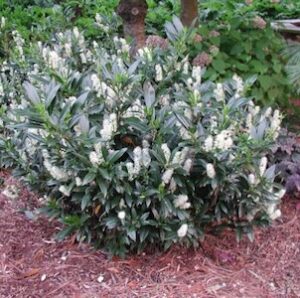
Lustrous leaves form a dense, low-spreading mound. Unlike many laurels that sprawl upward, Otto Luyken typically reach just 3 to 4 feet tall while spreading generously to 6 or even 8 feet wide. This makes it an exceptional choice for low foundation plantings, slope stabilization, and even mass planting where height is not wanted but year-round structure is essential.
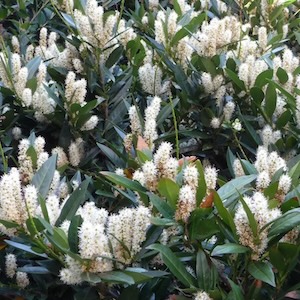
In spring (April into May) plants produce upright racemes of small, creamy-white, almond-scented flowers. These blooms are not showy in the manner of a rhododendron, but they are charming and, importantly, attractive to pollinators. Small dark fruits follow in mid-summer, eagerly taken by birds.
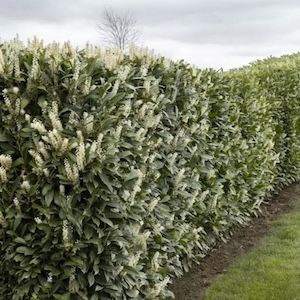
‘Schipkaensis’ – derived from the Shipka Pass in the Balkan Mountains of Bulgaria, where this hardier strain of cherry laurel was collected – is a different proposition altogether. Where Otto Luyken stays low, the Skip Laurel reaches for the sky: a vigorous, upright shrub capable of reaching 10 to 15 feet at maturity, with a spread of 5 to 7 feet.
The foliage is more robust – larger, broader leaves of the same waxy deep green. The overall effect, especially in a massed planting or formal hedge, is solid – an anchor in a garden through every season.
Spring brings the same racemes of white, fragrant flowers, often appearing in greater abundance than Otto Luyken, owing to the plant’s overall vigor. These blooms are followed by the same small dark fruits, again valuable for wildlife. In a well-sited privacy screen planting, the combination of flowering interest, summer foliage, and fall fruit can support a surprisingly diverse range of insects and birds. And the dense branching habit provides an excellent nesting site for songbirds.
Choosing the Right Laurel for Your Garden
| ‘Otto Luyken’ | ‘Schipkaensis’ (Skip) | |
|---|---|---|
| Form | Low, wide-spreading mound | Upright, columnar to oval |
| Height | 3–4 ft | 10–15 ft |
| Width | 6–8 ft | 5–7 ft |
| Hardiness | Zones 6–9 | Zones 5–9 |
| Best Use | Foundation, massing | Privacy screen, hedge, specimen |
| Sunlight | Full-sun to part-shade | Full-sun to full-shade (not robust in full shade conditions) |
| Bloom | Creamy white flowers April – May | Dense white flowers April – May |
| Pruning Needs | Minimal; trim after bloom | Annual shearing if used as hedge |
| Deer Resistance | Good | Good |
Four Ways to Use Laurels in the Landscape
The Woodland Edge
Otto Luyken laurels are ideal for the planting at the woodland edge, offering low, evergreen structure that defines spaces while blending seamlessly into natural plantings. Shade tolerance and deer resistance makes it a perfect choice.
The Green Screen
Plant Skip Laurels 5 feet on center along a property line or fence for a dense, year-round privacy hedge. Within three to four years, you’ll have a wall of green 8 to 10 feet tall.
The Foundation Planting
‘Otto Luyken’ excels at the base of a house where many shrubs grow too tall. Its natural low form rarely requires corrective pruning to stay below windows, making it genuinely low-effort in this high-visibility location.
Mixed with Broadleaves
Combine Skip Laurel with hollies, viburnums, or native inkberry for a multi-textured evergreen border. The bold laurel leaf contrasts beautifully with the finer textures of these companions and fills gaps through winter.
Essential Care
- Soil: Well-drained, moderately fertile soil. Both tolerate clay if drainage is adequate. Avoid waterlogged sites – root rot is the primary killer of laurels.
- Watering: Water consistently through the first growing season to establish deep roots. Once established, both are remarkably drought-tolerant, especially Otto Luyken.
- Fertilizing: A balanced slow-release fertilizer in early spring is sufficient. Avoid high-nitrogen feeds late in season, which can stimulate tender growth vulnerable to winter burn.
- Pruning: Use hand pruners, not hedge shears, on Otto Luyken to preserve leaf integrity. Prune in late spring after flowering or mid-summer.
- Transplanting: Both transplant readily when container-grown. Spring and early fall are ideal. Avoid planting in summer heat or just before hard freezes.
Dependable, beautiful, and genuinely easy to grow — the cherry laurels may lack the glamour of showier shrubs, but in the long life of a garden, it’s the often reliable ones that matter most.