A Tangled Skein
Note: We loved this North Creek’s Space Invaders series a lot! So much we have reposted it in it’s entirety, reprinted with permission from our friends at North Creek Nurseries.
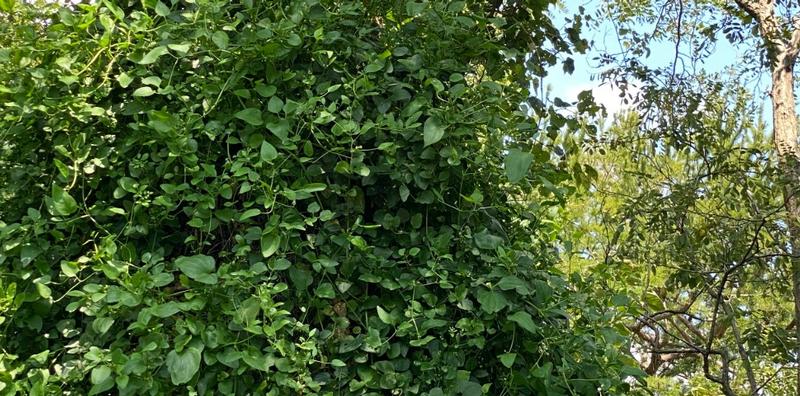
August means one thing: the vines are taking over. Climbing trees, smothering shrubs, and creeping over everything in sight, invasive vines can quickly take control. Time to fight back and reclaim the landscape!
Plant Invaders: A Tangled Skein
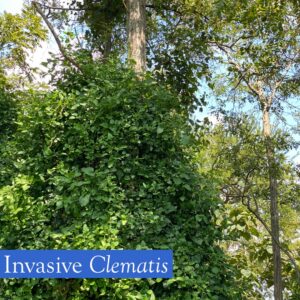
August. The hottest and most humid month of the year. Between the drought periods and heavy rainfall, the landscape is well into its jungle period. The crabgrass shoots up in the lawn even when mowing happened just the other day; the nutsedge has proliferated in the garden beds, and the vines, oh the vines. They crawl and clamber and creep every which way, over the shrubs, up the trees, covering the fence lines, and carpeting the paths. This is the season of the vine. With the heat and humidity, anything that can be smothered is being smothered. What can one person do against such an onslaught?
What… now?
Now is an excellent time to wrangle vines into some semblance of control. Depending on the vine, this is the time to tie it back into the arbor or hack it back to the ground. In most cases, the vines either haven’t flowered or, if they have flowered, haven’t set fruit yet, so you can get them back under control without fear of spreading seed around. If a vine is invasive, severing the top from the roots in the August heat will cause the plant to wilt. If it’s all wilting by the end of the day, great work; next task. But if half the plant is still thriving, it’s an indicator that you’ll need to hunt around some more to find the other stems. So, while this might be the stickiest time of year, it’s also prime time to scurry along the underbrush and manage vigorous overgrowth of weedy vines.
Identify the Suspects
North America is home to many a fine vine, providing beauty, habitat, and nourishment. Not all vines are wild interlopers, but even some North American native vines can be unruly. The first thing to do before you take a hatchet to everything is identify what you are looking at. Once we know the culprit, we can make a management plan.
Some of our native vines, from commonly planted in the landscape to less common but can show up:
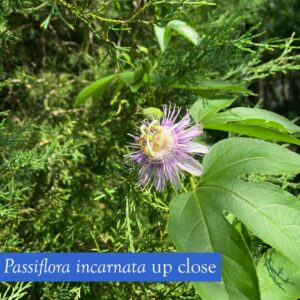
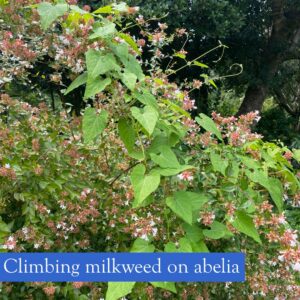
Passionflower, Dutchman’s Pipe, Coral Honeysuckle, Pearl Milkweed vine, air potato, bramble, Old Man’s Beard, American Wisteria, Trumpet vine, poison ivy
Not an exhaustive list of the alien invasive vine species in our area:
Ivy, Autumn Clematis, Japanese Honeysuckle, Japanese hops, Asian wisteria, Porcelain berry, Asian bittersweet, multiflora rose
If you have invasive vines in your landscape, go on and skip ahead to the “Got to Go” section.
Know How They Climb
Vines are characterized by long, flexible stems and specialized structures that enable the plant to reach the open canopy. Most vines are not self-supporting and need help to climb. How they attach affects strategies for managing the vine’s growth.
Twining: When the vine twists and winds around a structure, holding it closely, to support itself. Examples: bittersweet, honeysuckle, pearl milkweed vine, air potato
Hooks/thorns/prickles: Not just for protecting the vine against herbivores, small, pointy hooked growths on vines can allow them to scramble their way up. Examples: bramble, wild rose
Tendrils: Small, leafless growths that wind around objects to gather support. Examples: grape, passionflower, greenbriar, porcelain berry, clematis
Clinging/Root climbing: Clinging vines have tiny aerial roots or sticky adhesive pads that attach to firm surfaces. Because of their close contact with surfaces, they can damage structures. Common examples: poison ivy, Virginia creeper, ivy, trumpet vine
What to do
Now that we’ve identified this jungle of growth and observed how it grows, we can decide how badly it needs to be tackled. Generally speaking, we break it up into these camps:
Know How They Climb
Vines are characterized by long, flexible stems and specialized structures that enable the plant to reach the open canopy. Most vines are not self-supporting and need help to climb. How they attach affects strategies for managing the vine’s growth.
Twining: When the vine twists and winds around a structure, holding it closely, to support itself. Examples: bittersweet, honeysuckle, pearl milkweed vine, air potato
Hooks/thorns/prickles: Not just for protecting the vine against herbivores, small, pointy hooked growths on vines can allow them to scramble their way up. Examples: bramble, wild rose
Tendrils: Small, leafless growths that wind around objects to gather support. Examples: grape, passionflower, greenbriar, porcelain berry, clematis
Clinging/Root climbing: Clinging vines have tiny aerial roots or sticky adhesive pads that attach to firm surfaces. Because of their close contact with surfaces, they can damage structures. Common examples: poison ivy, Virginia creeper, ivy, trumpet vine
What to do
Now that we’ve identified this jungle of growth and observed how it grows, we can decide how badly it needs to be tackled. Generally speaking, we break it up into these camps:
Got to Go
If the vine is invasive AND attaches to buildings or other plants by aerial roots, it’s got to go.
Usually, this is for ivy. We cut it at the base of a tree or building and then apply systemic herbicide concentrate to the cut. If looks aren’t a big factor, we make a second cut 6-12” higher than the first and rip out that section of attached vine. Cut out a large enough section of vine so the top cannot reattach to the bottom. The top of the vine will die and eventually slough off the tree or building with time. If looks are important, it will need to be painstakingly removed.
If the vine is invasive and twines or has tendrils, cut it back to the ground and apply systemic herbicide to the cut. Remove all top growth. Bag and throw away top growth if there is fruit set. If no fruit set, plant material can be left to wilt and die on an impenetrable surface before being dragged to a fire.
If the vine is native but, on a building, and attaches by aerial roots, it’s got to go too. Mostly, trumpet vine and Virginia creeper are in this category because of their vigorous growth, which can smother a tree or building quickly. Both of these plants have their place, but I have also seen them pull down a power line pole and a shed, so let them grow unchecked at your own risk. This is doubly important for poison ivy, which flowers and fruits as it matures and grows vertically. If you want to discourage the spread of poison ivy in your immediate vicinity, cutting the stem like you did the English ivy and poisoning it is the way to go. Be sure to wear protection, however. I’m also on team “got to go” for air potato because that plant can smother a shrub border in no time and those little potatoes just drop everywhere, making hundreds of new plants. However, the only way to get rid of air potato is to dig up the little potatoes. It laughs at your herbicide. It’s a great native plant and makes edible little growths when it’s in the woods. In a garden, however, it will smother all your plantings.
Hack Back
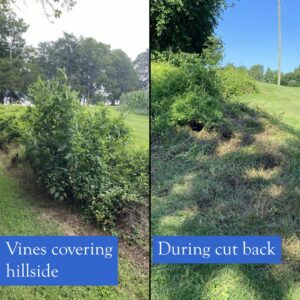
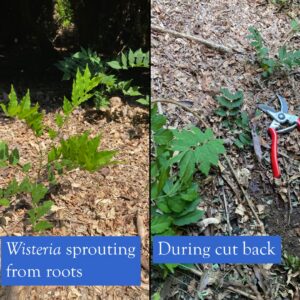
Brambles and briers are all treated with the whack-and-hack method of garden maintenance in late summer. At this point of the year, their thorny growth is clambering all over everything and being a nuisance, so a hard cut won’t kill it, but it will be less annoying. Brambles tend to take over if you let them go too long – the vines quickly make roots where they touch the soil. Established American wisteria also benefits from a touch of the whack-and-hack method, especially if it’s throwing up tendrils from the roots. Now, lovely displays of wisteria trained along wires at the front of a house or over a fence use a different technique and aren’t covered in this article. But for unruly wisteria that’s scrambling and twining up trees, the whack-and-hack method is going to be the people’s champion. If honeysuckle is strangling a beloved plant or about to become one with a fence, a heavy cutback can be appreciated. Tender shoots will emerge from the cut point, and it’ll be flowering twice as hard in no time.
We can fix this
For less aggressive vining species, plants such as passionflower, clematis, honeysuckle, grape, and American bittersweet can be carefully trimmed and trained. While some may prefer to let these things grow on their own, if they are growing over perennials, letting even the most well-behaved vine explore as it will and can smother and kill plants. Shockingly, trumpet vine can be managed with a hard trim at this time of year (as long as it’s attached to something that can bear its weight and its roots are corralled). Perennial passionflower (or maypop) tends to pop up wherever it wants along its long roots, so cutting back tendrils when they wander can help corral its growth near its planned support. Tendrils of clematis and honeysuckle can be woven in on itself to curtail its questing growth. Climbing roses can be tied into their arbors, trees, or fence lines. For the vines you want to be there, now is the time to tie them to their supports and manage their growth before winter.
Time for a Cut Through
While the heat is on and the sun is high, we encourage you to make your way through the landscape and wrangle those vines. There’s a point in the summer when, if you time it correctly, you’ll be early enough to knock the vines back and prevent seed from spreading, and late enough that there won’t be enough growing season for more vines to pop up and need management. Each location will have a different window, and some areas with long growing seasons will need more than one foray into the garden to manage vine growth. But for those of us in the Mid-Atlantic, it’s time to suit up and manage those aggressive vines.
More from North Creek’s Space Invaders series:
Poison ivy | Sweet Autumn Clematis | English Ivy | Multiflora rose | Japanese stilt grass | Privet | Bindweed | Breeding ‘non-invasive’ cultivars | Eat your foes!